
Fitness isn’t just about building muscle or losing weight anymore. It’s also about getting your body ready for the demands of everyday life. Functional training fills the gap between going to the gym and doing everyday things like lifting groceries, chasing after kids, or even just climbing stairs without getting tired.
This method focuses on multi-joint movements that are similar to everyday tasks, which improves strength, balance, and coordination as a whole. Functional training works out several muscle groups at once, which is better than traditional isolation exercises. This makes it a great way to improve performance and lower the risk of injury.
Table of Contents
Functional training has gained popularity for good reason. It draws from principles like the kinetic chain theory, where movements involve interconnected body parts working together, much like in sports or routine chores. If you’re tired of workouts that leave you strong in the gym but struggling in life, these seven functional training workouts are your gateway to transformation.
Backed by science and designed for all levels, they’ll help you build a resilient body ready for anything.
What Is Functional Training?
Functional training is all about doing exercises that make it easier and more efficient for you to move around in your daily life. It started out as a way to help people get better after an injury, but it grew into a popular fitness method thanks to programs like CrossFit. The American College of Sports Medicine (ACSM) endorses it for enhancing athletic performance through progressive overload on multi-planar exercises.
Unlike bodybuilding, which isolates muscles (e.g., bicep curls), functional training uses compound movements to train the body as a unit. This leads to better neuromuscular coordination, where your brain and muscles communicate more effectively for fluid motion. Studies show it can significantly improve physical and technical performance in athletes, though results vary based on program duration and individual experience.
The Benefits of Functional Training
There is strong evidence for functional training, coming from systematic reviews and expert opinions. A 2021 review in Frontiers in Physiology looked at nine studies and found that it helps athletes get faster, stronger, more powerful, more balanced, and more agile.
It also helps them get a little better at endurance and flexibility. There were no major changes in body composition, probably because the participants needed to change their calorie intake along with their training.
A systematic review published in BMC Sports Science (2025) analyzed 28 studies with 819 athletes, determining that functional training enhances both physical and technical performance. Some tests, on the other hand, didn’t show any difference from the usual ways of doing things.
People thought this was because the trials were too short or the athletes weren’t good enough. Live Science (2022) says that it stops muscle loss as we age, which helps older people stay active and lowers their risk of becoming disabled.
Key benefits include:
- Improved Strength and Power: Engages multiple joints for better force distribution, as per a PLOS One meta-analysis (2023) showing small to significant effects on muscle strength and power.
- Enhanced Balance and Coordination: Compound exercises distribute load evenly, reducing injury risk and improving daily tasks.
- Better Endurance and Flexibility: Builds muscle endurance, and one review said it made flexibility a little better.
- Performance in Specific Sports: A 2022 Frontiers review connected it to athletes being able to sprint, jump, and move around better.
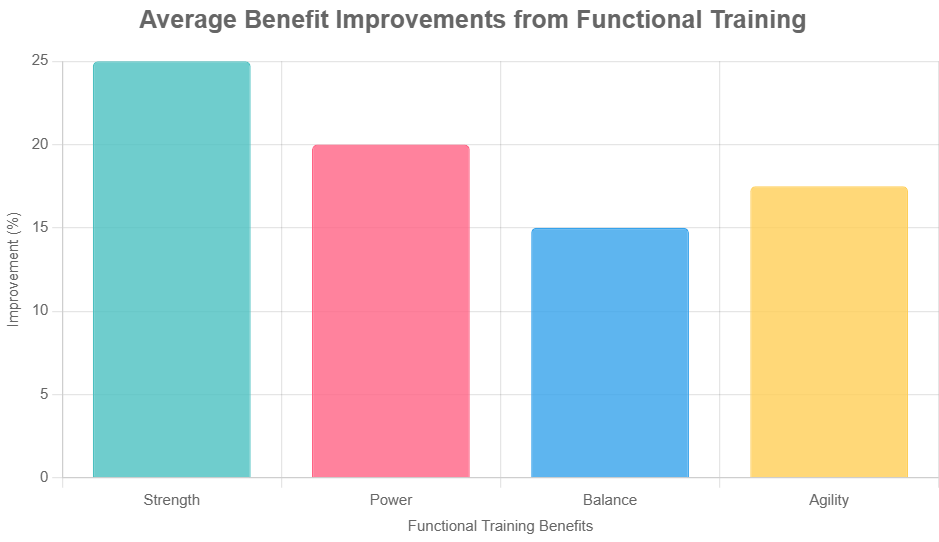
To see how things have gotten better, look at this table that shows the average gains from studies:
| Benefit | Average Improvement (from Reviews) |
|---|---|
| Strength | 20-30% in muscular strength |
| Power | 15-25% in explosive power |
| Balance | 10-20% in stability tests |
| Agility | 15-20% in change-of-direction |
| Endurance | Moderate gains (no specific %) |
These figures are averages from sources like Frontiers and PLOS One, varying by program length (typically 6-12 weeks).
The 7 Functional Training Workouts
These workouts are selected for beginners to intermediates, focusing on accessibility. Start with bodyweight versions; add weights as you progress. Do each exercise for 10 to 12 reps, three times a week. Do some light cardio for 5 to 10 minutes to warm up.
1. Bodyweight Squats
Squats are like sitting and standing, but they work the lower body and the core at the same time for stability.
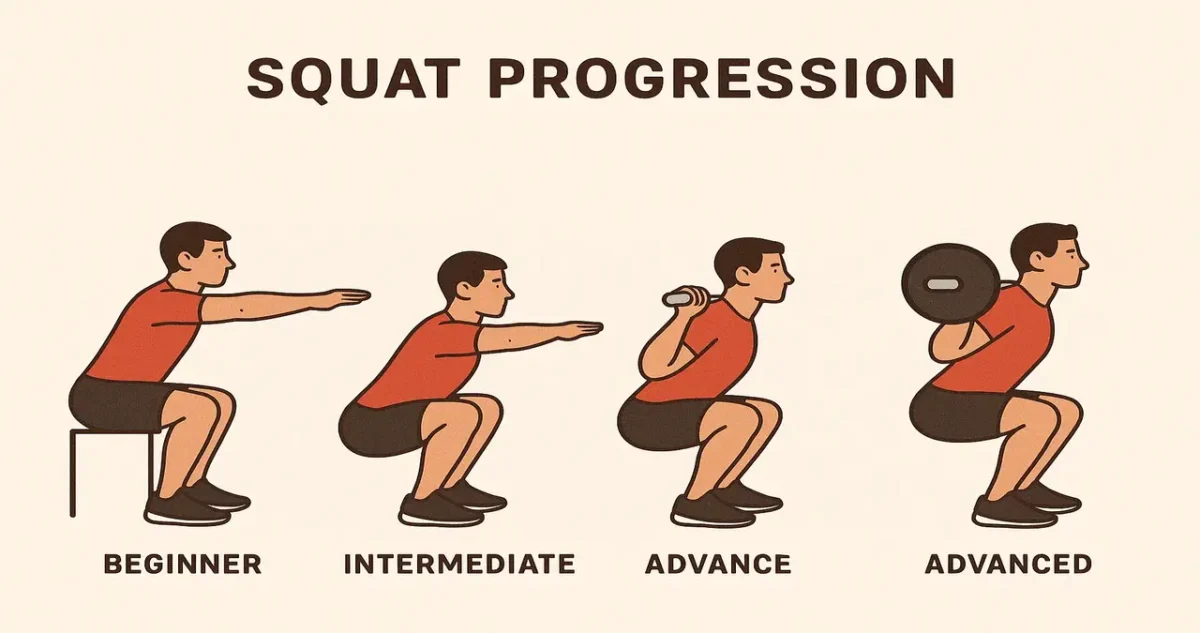
How to Do It:
- When you stand, your feet should be a little wider than your shoulders.
- To lower your body, bend your knees and push your hips back, like you’re sitting in a chair.
- Your knees should be behind your toes, and your chest should be up. Go until your thighs are level with the ground.
- To get up, push through your heels.
Benefits: Builds quad, glute, and hamstring strength; improves posture and reduces knee injury risk, per ACE Fitness. Variations: Add dumbbells for goblet squats.
2. Lunges
Lunges enhance unilateral strength, crucial for walking or climbing stairs.
How to Do It:
- Take a single stride forward and bend both knees to a 90-degree angle.
- Front knee stays over ankle; back knee hovers above ground.
- Push back to start; alternate legs.
Benefits: Boosts balance and leg power; a study in Frontiers showed agility gains. Variations: Reverse lunges for less knee strain.
3. Push-Ups
This upper-body staple builds pushing strength for tasks like opening doors.
How to Do It:
- Start in plank position, hands wider than shoulders.
- Lower chest to floor, elbows at 45 degrees.
- Push up to start.
Benefits: Strengthens chest, shoulders, triceps; improves core stability, reducing back pain risks —variations: Knee push-ups for beginners.
4. Planks
Planks are foundational for core stability, supporting all movements.
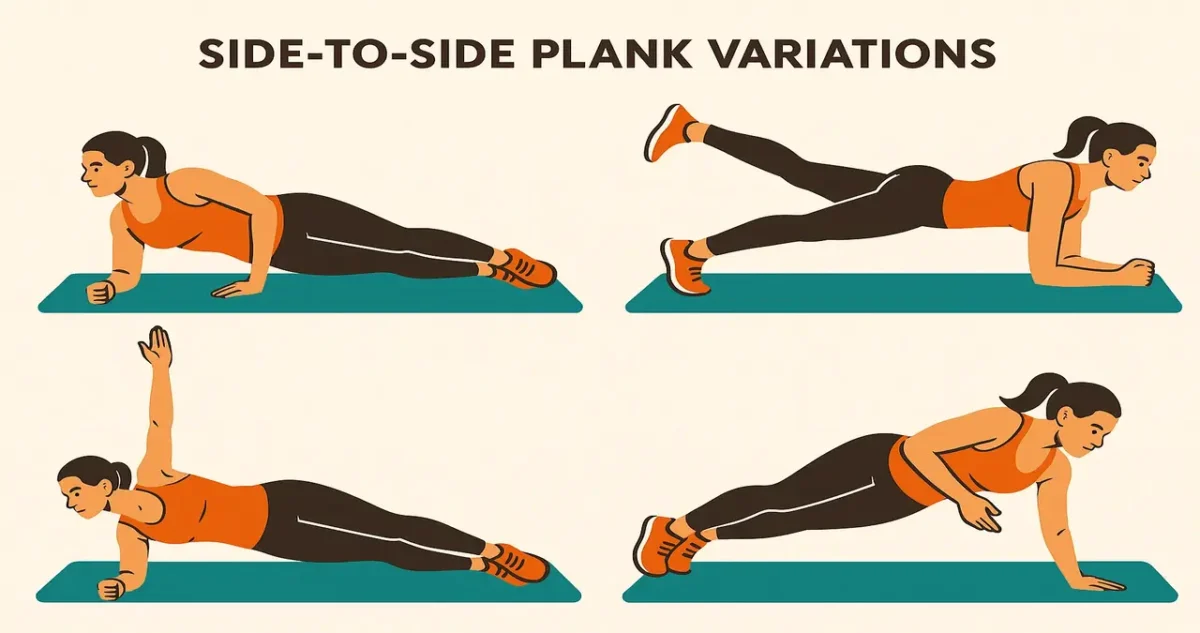
How to Do It:
- Hold forearm plank: Elbows under shoulders, body straight.
- Engage core; hold 20-60 seconds.
Benefits: Enhances endurance; BMC review noted balance improvements—variations: Side planks for obliques.
5. Deadlifts (Romanian or Conventional)
Deadlifts train lifting, vital for picking up objects safely.
How to Do It:
- Place dumbbells or a barbell in front of you and place your feet hip-width apart.
- Hinge at the hips, lower weights while keeping the back flat.
- Drive your hips forward to stand.
Benefits: Targets the posterior chain; prevents lower back injuries, per Harvard Health—variations: Single-leg for balance.
6. Kettlebell Swings
This explosive move builds power for dynamic activities.
How to Do It:
- After swinging the kettlebell between your legs, raise your hips to your chest.
- Keep core tight, back straight.
Benefits: Improves power and endurance; PLOS One meta-analysis showed sport-specific gains—variations: Bodyweight hip thrusts.
7. Medicine Ball Slams
Slams release stress while building full-body power.
How to Do It:
- Hold the ball overhead, slam to the ground with force.
- Squat to pick up; repeat.
Benefits: Enhances coordination; Frontiers review linked to better jumping and movement. Variations: Overhead throws.
How to Get Started
Start with two to three sessions a week and pay attention to your form. Check your progress and make changes based on how far you’ve come. Doing this with cardio will give you the best results. Talk to a doctor if you haven’t worked out in a while.
A Sample Routine:
- Monday: Three sets of squats, lunges, and push-ups.
- Wednesday: Planks, deadlifts, and swings.
- Friday: Full circuit and slams
Hydrate, eat protein-rich meals, and rest.
FAQs About Functional Training Workouts
What is functional training?
Functional training is a type of exercise that focuses on movements that are similar to things you do in real life, like squatting, lifting, or pushing. It works on several muscle groups and joints at once to make you stronger, more balanced, more coordinated, and more mobile. It focuses on compound movements instead of single exercises like bicep curls to improve daily function and sports or everyday tasks. This method came from rehabilitation and is supported by groups like the American College of Sports Medicine because it works.
What are the benefits of functional training?
Functional training has many benefits, such as making you stronger, more powerful, more balanced, more agile, and more enduring. Frontiers in Physiology says that it can help athletes get stronger by 20–30% and more powerful by 15–25%. It can also help them become more flexible and last longer. It also lowers the risk of injury by strengthening stabilizer muscles, improves posture by making the core more stable, and helps with weight loss by getting the whole body moving and speeding up metabolism. It helps older people keep their muscles and mobility, which makes daily tasks easier and safer.
How does functional training differ from traditional strength training?
Yes, functional training is suitable for beginners and can be adapted to any fitness level. Begin with bodyweight exercises like squats or planks, and then move on to weighted versions as you get stronger. It emphasizes good form to avoid injury, and modifications like knee push-ups make it easier to do. At first, experts say to work out 2 to 3 times a week, and if you need help, get it from a trainer. Many beginners see improvements in mobility and strength within weeks, making it an encouraging entry point to fitness.
Can beginners do functional training?
Yes, functional training is suitable for beginners and can be adapted to any fitness level. Begin with bodyweight exercises like squats or planks, and then move on to weighted versions as you get stronger. It emphasizes good form to avoid injury, and modifications like knee push-ups make it easier to do. At first, experts say to work out 2 to 3 times a week, and if you need help, get it from a trainer. Many beginners see improvements in mobility and strength within weeks, making it an encouraging entry point to fitness.
How often should I do functional training?
Most people should have 2 to 3 sessions a week to give their bodies time to heal while also getting stronger and more flexible. Each session lasts 30 to 60 minutes and focuses on circuits that work the whole body. Beginners should start with this frequency to avoid overuse, while advanced individuals might add more days with varied intensity. Consistency matters more than frequency—combine it with rest days and activities like walking. Always listen to your body and consult a professional if you have health concerns to prevent injury.
Conclusion
Conclusion
Functional training is not just a trend; it’s a way to improve your life that science backs up for long-term fitness. Incorporate these workouts, and you’ll notice more manageable daily tasks, better posture, and reduced injury risk. The most important thing is to be consistent. Start today and change your body for tomorrow.
Also Read This: Natural Thigh Fat Loss: Proven Diet & Exercise Tips for Effective Results
Also Read This: 7 Hacks to Increase Height Naturally | Proven Method
